

How Much Does It Cost to Build a House in Melbourne? – Full Guide
Building a custom home is likely to be amongst the most substantial financial commitments you make in your life. As such, you’ll likely only embark on this endeavour once or twice in your lifetime – so you want to make sure you do it right.
In other words, this isn’t the time to cut corners or make compromises. Going into this process with a clear understanding of the costs involved can help you make decisions with the utmost confidence – and trust us, there are plenty of decisions that you’ll get to make when building a custom home. From selecting between premium building materials like Italian marble benchtops and Acacia wood cladding, to optimising your floorplan to include spacious bedrooms and outdoor entertaining amenities, every decision you make in your home build will add to your bottom line.
With Melbourne’s property scene, the cost of your home build may also be influenced by market factors like the location and value of your land plot, builder rates per square metre, and other building costs, and other lesser known expenses like council fees for subdivision and building permits. Whether you’re planning to construct a modest two-bedroom townhouse or a spacious five-bedroom family home, understanding the price range that you can anticipate upfront will undoubtedly help you make smarter, well-informed decisions throughout the course of your build.
So how much might it cost for you to build your dream home in Melbourne? Our expert home builders in Melbourne are here to answer this question for you today. In the guide below, we’ll be outlining the current costs involved in building a home in Melbourne, including more information on some of the market factors that influence your bottom line – from suburb demographics and values, to building materials, rates per square metre, and more.
How much does it cost to build a house in Melbourne?
In Melbourne, the cost to build a custom home can range from anywhere between $2000 to $4000 per square metre. Overall costs for a home build in Melbourne can vary on the level of customisation, the materials used, your development timeline, and other factors.
For larger, premium homes like multifloor homes, luxury home builds, or dual occupancy properties, the cost to build may naturally be higher. Consult with our custom home builders at Ozcan Group for a detailed cost breakdown on your unique home building project.
Key factors influencing construction costs
As you might expect, there are a number of different factors that can also influence the final costs of your home build alongside the materials you use. Below, our custom home builders have included the top factors that are most often overlooked.
Build timeline
When you work with a home builder, they’ll provide you with a project timeline that outlines when you can expect your build to be completed. If that timeline is too long, you can request a streamlined approach, however this may require a larger workforce and thus more labour hours to account for you in your final costs.
Alongside timelines, construction demand cycles can also greatly influence the pricing of your home build, with peak building times accruing premium rates. Adverse weather can also impact building timelines, prompting building teams to amend project schedules to work around rain, thunderstorms, etc. Although weather delays can result in higher building costs, works like pipelaying run risks of damage to building materials if installed in adverse weather, which may result in even more costs associated with replacing materials.
Build quality and characteristics
As mentioned, swapping out standard building materials for luxury materials from designer suppliers can add to your building costs per square metre. However, there are other ways for your build characteristics to influence your total build costs.
For example, in Australia, we’re seeing more home builds be designed with bushfire and flood resistance in mind, or even passive heating and cooling features for climate-conscious energy efficiency. These unique building characteristics and methodologies may require input from specialised engineers, architects, and build teams, which can also influence the final costs of your home design.
Land quality and site preparation
Soil testing is fundamental to preparing your site for a construction project, so both soil tests and other land surveying tasks should be factored into the budget for your build. If soil tests and other surveying tasks return poor results (i.e. soil quality is not conducive to supporting a property foundation, for instance), further measures like levelling and soil building may be necessary. For instance, for properties being built on a sloping lot, soil levelling and other landscaping may be required, which will ultimately add to the final costs of your home build.
If you’re planning a knockdown rebuild, costs of demolition and site clearing and preparation will also need to be factored into the budget for your build. Consequently, site preparation will also be a larger component of your overall build timeline.
Government grants and concessions
In Victoria, first home buyers are incentivised to build homes in new suburbs through the State Government’s First Home Owner Grant program. The $10,000 grant can help reduce the overall cost of your home build, supporting first home buyers to get on the ladder.
If you’ve looked into government grants and concessions for first home buyers, then you’re likely already familiar with the stamp duty concession that allows buyers to purchase their first home without having to pay stamp duty. But did you know that when you build a new home, you only pay stamp duty on the purchase of your land, and not on your build? As land plots generally maintain lower stamp duty rates when compared to rates on established homes, building a home can be a lot cheaper than buying not only for first-time buyers but also for owner investors looking to avoid buying established properties with steep stamp duty.
Location and local building codes
Alongside land prices and labour costs varying from inner city to outer suburbs, other expenses like council fees and permits can also impact the final cost of your home build. As inner city council districts are likely to have more complex building codes and regulations (to accommodate more compact civil infrastructure), building permits in these areas may be valued accordingly, resulting in increased costs for your building project.
Note that adhering to more complex region-specific building codes may also influence labour costs. This is also a major contributing factor to higher local labour costs in inner city metropolitan areas across Melbourne.
Design specifications
The size and structure of your home build will also influence your final construction cost in more ways than one. For example, multifloor builds require more complex foundations, extra structural supports, and extra build materials (i.e. stairs, bannisters, etc.).
Similarly, for each enclosed bedroom included in your floorplan, you’ll also need to allocate a budget for fixtures like built-in wardrobe or closet space, windows, doors, split system units, and other heating and cooling amenities.
Finally, unique landscaping (i.e. garden pathways, drought-tolerant garden designs, etc.) and outdoor entertaining facilities (i.e. shaded pergolas, outdoor kitchens, etc.) will also influence the final costs of your home build.
Build comparison costs: Off the plan vs. custom vs. luxury vs. multi-unit developments
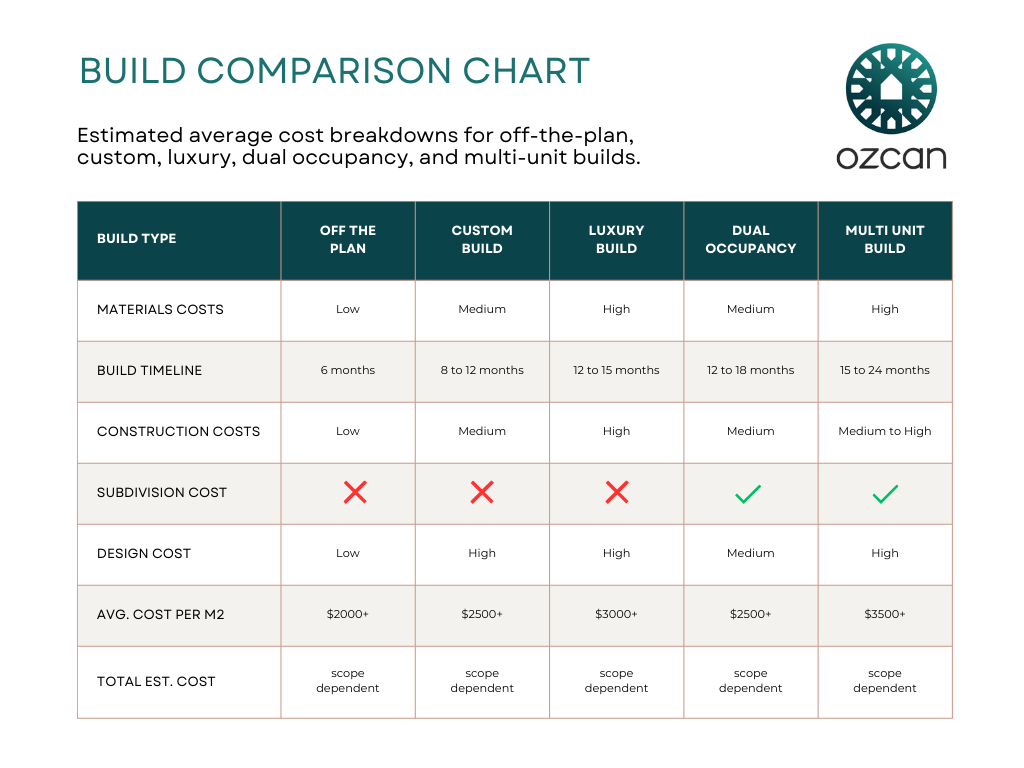
At Ozcan Group, we offer a variety of home building services, including custom home builds, luxury or boutique home builds, and even multi-unit developments. Naturally, each of these build types are accompanied by their own average building costs, which will need to be factored into your budgeting as a prospective home builder or for property investors looking to build bespoke multi-unit developments (i.e. unit or townhouse complexes).
Below, we’ve prepared a table that breaks down average estimated costs for the build services we provide, to help you plan your building project with the utmost confidence. Note, the below table also includes estimations on build timelines for each of these project types, as well as associated costs like the costs of subdivision.
What are the most affordable suburbs to build in Melbourne?
Northern growth corridor
In Melbourne’s outer north, the council districts that attract the highest rates of first-home buyers include the City of Whittlesea, City of Hume, and the Merribek Council district further south, which includes suburbs like Glenroy, Coburg, and Pascoe Vale South.
Here are some of the top suburbs within those council districts that promise strong access and affordability for first-home buyers.
Greenvale
Located just 20km north of the CBD and in close proximity to the Tullamarine International Airport, Greenvale is renowned for its abundance of green spaces and availability of larger residential land plots.
Craigieburn
Located 25km north of the CBD, Craigieburn has been topping lists of Melbourne’s most affordable suburbs for first-home buyers and home builders for over two decades. Being a major suburb located within Melbourne’s outer northern growth corridor, Craigieburn offers quality schools, diverse local amenities, and strong accessibility, thanks to its position by the Hume Freeway.
Epping
One of the largest suburbs in the City of Whittlesea council district and located just 18km north of the CBD, Epping has had consistently strong infrastructure investments, making this suburb ideal for growing families looking to stay within range of the Northern Hospital, and even for commercial property investors looking for low-cost/high-return commercial investments.
The ongoing development of High Street, Epping into Epping Road that connects the suburb to Epping North also makes this suburb a high-growth opportunity for families looking to establish themselves in Melbourne’s outer north.
Mickleham
Located 29km north of the CBD, estates in Mickleham provide modern properties and off the plan opportunities, with rapidly developing infrastructure. The region’s swift transition from semi-rural to urban development has garnered Mickleham the reputation of being Melbourne’s fastest growing suburb, and with more infrastructure developments in the pipeline at Hume City Council, it’s likely the suburb will retain this accolade over the coming years.
Western growth corridor
The City of Wyndham, Melton City Council, and the City of Maribyrnong council districts comprise the bulk of Melbourne’s western growth corridor. Notable suburbs across this region include the up-and-coming suburb of Footscray as well as other suburbs located along the Maribyrnong River, connecting the west to the north-west (i.e. Moonee Ponds, Ascot Vale, Essendon, etc.).
Melton
Located 37km west of the CBD, Melton and surrounding suburbs comprising Melbourne’s outer western corridor have been recognised for their untapped potential in recent years. The region promises strong connectivity through the VLine rail services heading straight into the heart of the city, as well as the suburb’s proximity to the M8 motorway.
Maidstone
Maidstone and surrounding suburbs including Brooklyn and Braybrook, are just a stone’s throw from the CBD thanks to infrastructure like the Westgate Bridge and proximity to other major thoroughfares. Maidstone’s residential zoning promises easy access to units and townhouse developments, with reasonable subdivision rates offered by the City of Maribyrnong.
Williams Landing
Just 19km south-west of the CBD and a quick drive from Williamstown and Altona Beach, Williams Landing offers a more affordable alternative to coastal living when compared to more affluent suburbs like Brighton and other neighbouring south-eastern suburbs. Positioned with easy access to Point Cook, Werribee, and even Geelong further south-west, Williams Landing combines suburban living with an abundance of space that feels semi-rural despite the region’s blossoming civil developments.
Maribyrnong
Located just 8km north-west of the CBD, Maribyrnong is in high-demand across younger demographics including couples and working professionals. The area boasts an abundance of townhouse and unit developments, making Maribyrnong a great investment opportunity for property developers. The suburb’s proximity to parklands along the Maribyrnong River and the Highpoint Shopping Centre also provide ample lifestyle factors to this sought after market.
Inner/middle ring
Compared to the northern and western growth corridors, Melbourne’s inner suburbs that have been recognised as providing ample opportunities for builder investors focus less on affordability as a metric and more on sustaining value factors. Suburbs like Toorak and Templestowe provide higher costs for plots and established properties, however subdivision and knockdown rebuild projects may provide a strong ROI for property developers.
Toorak
Although Toorak is consistently in high-demand, there are still ample opportunities for property developers looking to subdivide and develop townhouse complexes and other types of multi-unit developments.
For those looking to build a luxury home, larger premium properties are also poised to grow in value faster in Toorak when compared to similar sized properties in Melbourne’s growth corridors.
Hawthorn
Sitting on the Yarra River and surrounded by diverse local amenities including the Yarra Bend Park, accompanying golf course, Burnley Gardens, and other attractions, Hawthorn is growing increasingly popular with families and young professionals. Median property prices for 2 bedroom dwellings can also reach upwards of $1 million, with values for standalone properties continuing to grow as they grow scarcer in comparison to multi-unit developments.
Moonee Ponds
A hotspot of commercial activity with a strong small business scene along the iconic Puckle Street, Moonee Ponds is renowned for its abundance of parklands, proximity to the Moonee Valley racetrack, and ongoing development of unit and townhouse complexes. With property in high demand, subdivision with the intent of developing multi-unit developments is likely to provide a strong ROI for property developers.
Aberfeldie
Moving back to the north-west now, Aberfeldie is a small yet high-opportunity suburb bordering Moonee Ponds on its north-west shoulder. The suburb’s proximity to the Maribyrnong River provides an abundance of green spaces for outdoor recreation including Aberfeldie Park.
Final average costs breakdown
To summarise, the average costs to build a home in Melbourne with standard building materials are as follows:
- Per square metre – approx. $2000 to $4000.
- Total build (standard 200-240sqm house) – approx. $430,000 – $920,000.
An example cost breakdown for a standard home build (single-storey 3-4 bedroom family home) is as follows:
- Construction – $300,000 – $350,000+
- Site preparation – $20,000 – $40,000+
- Fees and permits – $35,000 – $60,000+
- Contingency – $50,000 – $75,000+
Ready to build your dream home in Melbourne?
For first-home buyers looking to get their foot on the ladder, the idea of building your first home can naturally feel like a bit of a daydream. But as you can see from our guide, the right approach powered by careful and tactful planning may see you picking up the keys to your brand new home sooner than you think.
If you are still deciding between building or buying, our team at Ozcan Group hope that this overview has at least helped you better understand the financial realities of building a custom home in Melbourne so that you can plan accordingly from here.
And if you’ve already made your decision and are ready to kickstart your first home build, then don’t hesitate to contact us to schedule a consultation with our Melbourne home builders, or explore our project gallery to get a little inspiration for your home build planning.